Category Archives: Current Events

Eight Year Olds Dude

That classic quote from the character that spawned my blog’s name is one of many lines of dialogue and images born in the hilarious and off-center minds of the Coen Brothers for their opus, The Big Lebowski. Somehow, they even found a way to make pedophilia and perversion funny by creating and perfectly humanizing a grotesque, slimy, purple jumpsuit and hair-net wearing caricature named Jesus Quintana. And we all know now that “nobody fucks with the Jesus.”

But let me be clear: John Turturro’s Oscar-worthy performance notwithstanding, THERE IS NOTHING FUNNY ABOUT PEDOPHILIA, CHILD MOLESTATION AND CHILD ABUSE. EVER.

I feel a great number of awful adjectives today, and have ever since this story broke over the weekend. I am disgusted, disheartened, disappointed, frustrated, bewildered, angry and sad. But mostly I am sick. Fall to my knees, grab the sides of the bowl and turn my insides out sick about this whole tragedy currently gripping “Happy Valley,” and shocking the world around it.

I am not entirely sure where or how to begin, but for crying out loud, I know all of this should begin with the victims, however many there were, of this horrific and despicable crime and subsequent cover-up (and/or at the very least, lack of action and responsibility that allowed such heinous crimes to continue for nearly a decade and to affect and ruin the lives of countless other precious and innocent children and their families).

Imagine if you will the most shame and embarrassment you have ever felt (in a singular moment or for an extended period of time) in your entire life. Then do the same for the most frightened or fearful you have ever been. Then take those feelings and multiply their intensity by ten, or a hundred, or a million. Still, you have likely fallen short of the mark. I am not sure, if you have never been physically assaulted, violated nor had your innocence stolen from you at an early age (or any age, frankly), that you could possibly understand the intense shame, fear and self-loathing you would feel in the aftermath of such a traumatic event.

For some, that feeling might be able to be quashed, or at least tempered, gradually, with good therapy, loving friends and family, a strong foundation and sense of self and most importantly, with the passing of time. Those are the “lucky” few. For most, the nightmares will never ever end. The self-hatred, shame, fear and general depression will remain through the years, possibly even intensify, and certainly negatively affect their lives in every way imaginable, from performance in school and later work, to relationships with friends, family, boyfriends, girlfriends, spouses and possibly even their own progeny. Sexual abuse and trauma often creates or intensifies a number of mental health issues, including but not limited to depression, aggression, OCD, problems with authority, control issues (including eating, cutting and behavioral disorders), and certainly suicidal and even homicidal thoughts and tendencies.

Not only do we not know how many other young lives were affected and derailed by the perpetrator of these crimes (Mr. Sandusky), both before and after he was witnessed in the shower with a ten year old, but unfortunately we never will. Because one thing is for certain in situations such as this: For every brave child who comes forward, there are two, or three, or four or twenty, who can never muster the strength to do so. Furthermore, and this may be difficult to even process, but there may unfortunately be a few people who were abused and who are no longer with us today to come forward at all. These may have been the weakest of those victimized, and subsequently could not continue to live with the shame, guilt and fear. Their parents, god help them, probably wondered what could possibly have driven their precious children to such a horrible and “selfish” demise, not even realizing that a scenario as awful as this scandal may have stacked the deck unfairly against their children living a normal life, or living a life at all.  But also consider that Sandusky was 58 when he was “caught in the act” nine years ago. Predators of this nature rarely begin these deviant behaviors so late in life. It is certainly possible, and in fact, probable, that Sandusky was committing similar treacherous acts for decades prior to being seen in the showers in 2002. So it stands to reason that there may have been victims of his perversity who would be in their 50s today, or at least close to 50. Some of them, unfortunately, who lived with that kind of pain, shame and fear for so long, may simply have passed on rather “naturally” by now as well.

I realize that is awful to read about or even think about, but to me, the victims, all of them, at any age, whether dead or alive, must be remembered here and more to the point, measures need to be put into place to prevent similar predators from hurting more innocent children in the future. This is true in Athletic departments from little leagues all the way up through the NCAA system. It is also true in our religious organizations, our public and private schools, summer camps, scout troops and any other institution or organization where adults have unlimited and unsupervised access to children.

Casting blame here seems premature. There are an overwhelming number of people who deserve some serious blame and who have a great deal of explaining to do over the next few weeks. But there are a few things that cannot be said enough, and a few people involved, that really have no shot at coming up with an explanation that will satisfactorily remove any guilt from their defense nor blood from their hands.

We (and by we I mean society) must be careful in child abuse cases not to quickly come to judgment in favor of the children because lives can be ruined forever in the other direction by falsely accusing someone of such heinous crimes when in fact they were innocent. There have been cases of authoritative figures being unjustly accused simply because their students or parishioners or campers, et al, didn’t like them. There have also been plays and movies and books written on the subject: think Doubt. So there are dangerous and slippery slopes in both directions that must be navigated in these awful situations.

But this case is clearly not one of those “we can’t be sure if the allegations are true so we need to take our time” scenarios. An adult witnessed the accused of raping a minor in a shower. Furthermore, at least nine people, most of whom did not know one another at all, have come forward with additional accusations. I have no idea how or why charges were not brought against Sandusky nine years ago, and why he has not seen the inside of a jail cell yet to date. Something is clearly wrong with not only the people associated with the Penn State Football Program and University, but also with the process in general to bring child molesters to justice in the first place. Our children are not even safe once an offender is caught red handed, because of a number of factors, but the slow pace of our justice system certainly is among them.

Now let’s talk about Mike McQueary. Again, I do not want to rush to judgment until I have all of the facts. But from the facts that have leaked out thus far, it seems to me that we have a young man (28 at the time) who stumbled across a horrifying and gruesome scene in 2002, when he witnessed Sandusky anally violating a ten year old boy in a shower. There are very few of us who can honestly say for certain what we would do if we were ever in a similar circumstance. Sure, we would all like to believe we would act the hero, run into the showers and forcibly remove the perpetrator from the child, punch him out and say something macho like, “if I ever see you around here again, or even catch wind of you touching another child so help me god, I will kill you.”

The morally correct thing to do is to make sure of the safety of the child you witness being abused, whether by force or by vocally yelling for the criminal to leave. Then, any sensible and reasonable code of ethics mandates even further action, which is to do all you can to prevent such abuse of minors to take place ever again. That is to say, one should notify the police of what was just witnessed, and together with the victim you just rescued, a case should be made to ensure Sandusky or his likeness spends the remainder of his (or her) life behind bars.

It is not easy to do the right thing. That is why society respects heroes and do-gooders of all walks of life, and even celebrates them. Captain Sully, who despite all odds landed that plane in the Hudson and saved the lives of all of his passengers; those brave souls on United Flight 93, who prevented additional terrorist acts and saved the lives of countless people in Washington DC on 911; the first responders in New Orleans following Katrina, or in Haiti after the earthquake, or Indonesia after the tsunami; Rosa Parks, Harriet Tubman and countless others in the fight for civil rights; Oscar Schindler and myriad others who defied the Nazis (and other tyrannical leaders) to help those being terrorized and systematically killed; the students in Tiananmen Square who stoically stood before the oncoming tanks; and all of the fire and policemen who courageously charged into the towers of the World Trade Center on 911; and too many others to mention, but all of whom deserve high praise and gratitude.

Ironically, hero-worship and near deification is why Joe Pa, of all people, was so revered – it wasn’t just his 409 wins on the field, but rather everything he did and represented off the field that made the man such a legend in the once happy valley that is State College, PA, as well as all over the rest of our nation. I will come back to this point later.

Right now, I am focused on McQueary, who had a chance to be a hero and failed. Not all of us are cut out to be heroes. Most of us aren’t wired for it. It is impossible to say what we would do in situations like that McQueary found himself in nine years ago. And it is also impossible to say what the same man may have done in a totally different make or break scenario under different circumstances. Actions (or non-actions) make the man, so they say. None of us can choose the situations that may befall us in life, but all of us control how we react to them, and it is in those reactions that our true character shines through.

I can’t help but be reminded of the grim basement scene in Tarantino’s opus, Pulp Fiction, when Marsellus Wallace is being sodomized by Zed and Maynard while Butch is in the room next door, frantically trying to escape the ropes they had tied him up with and listening to the barbarism taking place through the wall. When Butch finally frees himself and gets away from the gimp, he charges upstairs and is seemingly liberated from the nightmare he had been part of. He was on his way out to rendezvous with his girlfriend and live the rest of his life in total happiness with the money he had scammed from Marsellus Wallace when his conscience grabs hold of him. He grabs a samurai sword off the wall and coaxes himself back downstairs into the horrifying basement rape scene that was still underway. Butch sliced and stabbed Maynard with the sword and eyed Zed, forcing him, at sword point, off of the large black man who had been Butch’s sworn enemy just minutes earlier. Then Butch teases Zed, almost begging him to make a move for the shotgun that leaned against the table beside them.

“Step aside Butch,” said Marsellus.

Marsellus blows a whole in Zed’s abdomen as Butch moves away.

After a long pause, Butch finally asks, “You okay?”

To which Marsellus replies, “Naw man. I’m pretty fuckin’ far from okay.”

And in that scene, Quentin Tarantino basically encapsulated our collective problem with Mike McQueary, by showing the exact opposite reaction to a similar scenario. Making matters worse, Butch hated Marsellus Wallace, and minutes earlier was trying to kill the man. But seeing and hearing these two perverts rape the man, Butch simply had to do the right thing, even for his sworn enemy, and so he reentered the house of horrors and freed Marsellus from his assailants.

When asked if he was okay, Marsellus’ brutally honest response seemed oddly tame, but we all knew exactly what he meant. And he was a 40 year old 250 pound crime boss who looked like he would win a fight with an entire football team. Imagine what a ten year old boy must feel like in a similar situation. And that is why we all demand more from McQueary here. I am not sure exactly what he did or said in the moment, but it obviously wasn’t correct or enough. Maybe he thought going to his boss and father with his troubling eyewitness account was enough. And maybe he was then misled by those who outranked him on the food chain to speak no further of the incident, and that it would be handled by others from here on in…either way, McQueary has some serious explaining to do and clearly dropped the ball, but perhaps other than his missed opportunity to do the right thing in the moment, we will come to see that while Mike was wrong, others may have prevented him ultimately from doing the right thing later, to protect themselves, their jobs, their program and their once esteemed University…we shall see.

Which brings us back to Joe Pa. And I will once again hold full judgment until I hear the entire explanation and course of action taken in 2002 following the incident as well as for all of the years since that date. But from everything I have read and heard so far Paterno really dropped the ball. He seemingly took the account of Sandusky to his “boss,” the AD, and left it at that. I have the following thoughts:

A)     Joe Pa has no boss at Penn State…he was the boss and final authority on everything in State College, PA, and not just for things concerning football…everything.

B)      I cannot say this for sure as I do not have all of the facts, but it does not sound like Joe Pa followed up with his AD or any other higher up at PSU after delivering his account to his AD in 2002.

C)      Based on his ridiculous message to those camped out on his lawn last night, where he referred to the victims as “victims or whatever they are” and then added this gem: “I think we ought to say a prayer for them because you know … tough life when people do certain things to you.” Tough life? That doesn’t even scratch the surface. And then he had the unmitigated temerity to start a pep rally chant. Seriously? How out of touch can a man get. Sure he is 84 years old, but he is ostensibly running a major college football program, right?

D)     I grew up a big-time Nittany Lions fan. My mother and many other family members and close friends went to PSU. I loved Joe Pa just like so many others out there. He was seemingly incredible on so many levels: a great coach, a great mentor, ran a clean program in an increasingly difficult environment to do so, placed education above all else, did so much for his community and those less fortunate. He is and has been a great man, and though a single moment or event can often define a man, I will do all I can to remember Joe Pa for the vast good he has done over a six decade career.

E)      But I cannot and will not ever forgive Joe Pa for this if it is confirmed that he found out anything untoward went on with Sandusky and a minor (graphic account or not) and all he did in the aftermath was deliver the news to his emasculated and un-empowered AD. Frankly, even if he did a little more than that (like maybe had a conversation with Sandusky, and even told him not to come around campus anymore, particularly with any children…which by the way, sickens me even more if Joe Pa knew enough to say something like that, which would mean he tacitly permitted such deviant behavior off campus). Joe Pa was deified on that campus and in that whole region of Pennsylvania. He was the law, the moral fiber and the pulse of that University. All eyes and ears were on him. For him to pass the buck, turn a blind eye and refuse to follow up to ensure appropriate action was taken in a situation like this with little children’s lives hanging in the balance is reprehensible, and frankly, almost as vile as the acts themselves. As a molder and shaper of young men, he had a moral and general responsibility to always do the right thing when it came to children, whether on his team or not.

F)      I can’t help but remember yet another classic movie relating to this ordeal, particularly the Joe Pa/Curley-Sandusky-McQueary dynamic which evokes the Jessup-Kendrick-Dawson/Downey hierarchy in A Few Good Men. (Again, I don’t yet know what, if anything Joe Pa said to Sandusky or McQueary following the incident in 2002, or whether he and/or Curley ordered McQueary to remain silent). But anyway, at the end of the movie, when Jessep is found guilty, young and naïve PFC Louden Downey asks why he and Dawson are being discharged when Jessep admitted to ordering the code red. Dawson’s response is chillingly fitting here: “We did nothing wrong,” said Downey. “Yeah, we did. We’re supposed to fight for people who can’t fight for themselves. We’re supposed to fight for Willy.” I hope I don’t need to draw the parallel here for you.

G)     And that about sums it up in my mind.

My final thoughts center around this “scandal” as a far more profound, but generally similar statement on the current state of collegiate athletics in our country. While the rape and subsequent cover up of child molestation is far worse according to the moral code of society than many of the other scandals that have rocked college campuses in the past few years, they all highlight a troubling trend that is becoming increasingly prevalent on campuses throughout our nation. The fact is that as more and more money is thrown at collegiate athletics (particularly football and basketball), these programs become way too powerful to be properly managed and overseen by their schools in general. And the leaders of these programs, who often earn more money per year than all other college officials and professors put together, often become power-driven ego maniacs who care only about winning and are willing to sacrifice their entire moral code to that end. Whether it is trading tattoos for money and sports memorabilia, providing or turning a blind eye to extravagant yacht trips and strip club misadventures, allowing shady Ponzi-scheme operators to have training room and on field access to team members, overlooking petty crimes, drug use, and date rape scandals, arranging for sexual escorts during recruiting parties, ignoring or tacitly approving improper pay-for-play scenarios with boosters and countless additional improprieties that clearly occur on many if not all major college campuses with competitive division one athletic programs, college coaches and their programs are increasingly corrupted amid a failing system.

One thing is certain, a culture exists not just at Penn State, but at major division one Universities across our nation, that fosters an atmosphere where winning is more important than anything…including morality. And for this, we all suffer.

My hope is that something positive comes out of this tragedy. That serious money is donated not just by Penn State and the Big Ten, but by all of college athletics, to develop and strengthen the protection of our nation’s youth, through outreach programs, education and better systems for bringing deviants to justice…systems that make it easier for victims to come forward as well as to educate and motivate the families of those affected. I also hope the game on Sunday is cancelled altogether, because it just isn’t the right thing to do to play a game in the face of this awful scandal. This isn’t the aftermath of 911, where our nation is grieving and needs a distraction from what seemed to be the end of days. This is a contained tragedy that has plagued a community and shocked a nation, and while I realize that the players on Nebraska and Penn State are not to blame for this fiasco, and therefore should not be penalized when they work so hard all year to play football, we should all remember that LIFE IS NOT FAIR. It is one game. And playing football and cheering in that stadium is so wrong on so many different levels at this time.

Questions need to be answered. People need to be brought to justice. And the victims, those poor, brave tortured souls need time to air their grievances. Call off the game Penn State and the NCAA. For once, do the right thing here.

We all need time to digest this horrific turn of events. We all need time to heal. Eight year olds dude. They’re pretty fuckin’ far from ok. We need to fight for people who can’t fight for themselves.

God help those victims. God help their families. God help us all.

IDROS

1 Comment

Filed under Current Events, Sports

One Million Dollars….

The hikers’ release

For half a million a piece

Brings joy to our nation and friends;

But my logical fear

Which should loom loud and clear

When viewed through a pro-Israel lens:

Iran gained global cred

Just one day ahead

Of Mahmoud’s scheduled UN address;

He’ll use his goodwill

To slander Israel

And help out with Palestine‘s quest.

So congrats Josh and Shane

For an end to your pain

But your freedom is reason for pause;

The million we spent

Almost certainly went

To fund an undeniable cause:

To buy ammunition

And deadlier weapons

To point at Iran’s Jewish neighbor;

And the ransom, you see

Came from taxes and fees

Paid from American labor.


Leave a comment

Filed under Current Events, Politics

Maybe William Goldman’s mythical Fire Swamp exists…in California?

It finally happened.  Rodents of unusual size (R.O.U.S.’s) were recently spotted in our country, at a waste-water treatment facility in California. Not sure these R.O.U.S.’s are as dangerous as those braved and defeated by The Man in Black (Westley) and our fair Princess Buttercup outside of Guilder, and just beyond the famed Cliffs of Insanity. In fact, they may even be gentle like guinea pigs.

But still, one can only imagine the panic that might set in should a few people stumble across some lightning sand, or are charred by flame spurts in the next few weeks.

Just beware of the man with six fingers.

This entry is dedicated to the memory of Peter Falk, who recently passed – he will be forever remembered as Columbo, and the narrator of the timeless fairy tale that is The Princess Bride.

Leave a comment

Filed under Current Events

Of Fire and Ink: Discussions in the “wake” of a Jewish star’s death…

Amy Winehouse’s untimely though not unpredictable death this past week has focused many people’s attention on the eerie and tragic fact that a significant number of incredibly talented musicians have left our world at the far too young age of 27. Sure, psychological disorders and complications stemming from substance and alcohol abuse seem to be the common denominator in most, if not all of these unfortunate cases. Amy’s talent, like her predecessors, was undeniable; her struggles and inner demons well-documented; and her life cut way too short, unfairly robbing her family, friends and fans of many years of whatever Winehouse could offer: potential greatness, love, tabloid fodder, highs and lows. Even the disappointed fans in Belgrade, Amy’s last concert venue from which she was booed off the stage after forgetting her lyrics and stumbling across the stage early in her show, would surely prefer she lived longer, even in obvious pain, than meet such an early and seemingly catastrophic demise.

We were mesmerized, as is often the case, by the train wreck we were witnessing, knowing full-well of the carnage that loomed ahead.  And yet there was little we could do.  Hell, even her own mother, Janis (scary in and of itself), knew… she described it as being “like watching a car crash – this person throwing all these gifts away.” She admitted herself that her daughter’s death “was only a matter of time,” a shocking thing for a mother – Jewish or otherwise – to be able to say out loud.

And yet I am not so sure anyone could help Amy, even if they wanted to.  Her demons were too strong.  And, in fact, some people did NOT want to change her, or get her the help that inevitably would change her.

Check out this chilling snippet written by Dvora Meyers in Tablet this past April:

“Though she cloaked herself in the style and sound of girl groups from 40 years ago, Winehouse brought a thoroughly modern—and Jewish—sensibility to her lyrics and performances. She spoke not of love and romance, as her predecessors did, but of addictions, sex, and every Jewish girl’s favorite emotion: guilt. In her famously adenoidal voice, she sings about the men she will cheat on, those she will use up, and the ones she intends to spit out. Her songs and tone drip with regret, but also the inevitability of her bad behavior. Any astute listener knows that she’s not going to change. In fact, we hope she doesn’t.”

Well she didn’t, and alas, Amy is gone. Like Jimi, and Janis, Jim and Robert, Brian and Kurt and Pigpen before her, her music remains a constant and permanent reminder of an obscenely talented artist who left us far too early, in the prime of her life (at least by the numbers), leaving loved ones, fans and media to speculate on the “what ifs.”

Winehouse’s burial has garnered some serious attention as well, particularly among Jews.

You see, Amy Winehouse, the rebellious bad girl singer from Northeast London, was Jewish. And she was covered in tattoos, a seemingly mythical “no-no” in Jewish tradition. Making matters worse, Amy requested to be cremated after her death, a wish her parents granted. Cremation, too, is a Jewish taboo (yeah, yeah, I am angling to be the new Dr. Seuss, may he rest in peace).

And now scores of people are left to argue and debate whether Amy “deserved” to be buried in a Jewish cemetery (she was). Rabbis, scholars and ordinary Jews from every sect and geography are weighing in on these issues, potentially paving the way for a new generation of painted Jews to be barbequed and laid to rest among their ancestors – or conversely, forcing Bubbas and Zeydas all over the globe to add clauses to their last wills and testaments, forcing their grandchildren to think twice before getting drunk and permanently coloring their flesh with dolphins, barbed wire and kanji characters.

I have seen and heard a full gamut of questions and comments over the past few days, including whether Amy was cremated because she was covered in tats, and therefore couldn’t be buried like that in a Jewish cemetery. These questions and comments do not arise out of complete ignorance and disregard for religious laws, history and traditions. Rather, this piece will contend that the very evolution of religions precipitates a widening gap between the letter of religious laws, observances and traditions and their modern day interpretations and understandings (or lack thereof). Or, on second thought, maybe some questions and comments do emanate purely from ignorance and stupidity.

Either way, the debate is lively and healthy, and certainly not without merit.

In case you are wondering where these “rules” come from, how they came about and how they are interpreted across the Diaspora, allow me to briefly outline the basics:

I am not here to criticize the extremists, nor to lay a guilt-trip upon the atheists and lax followers of religious tenets. Far from it – who am I to judge? And though my thoughts below deal primarily with Judaism, the religion with which I am most familiar, the themes and opinions expressed in this essay apply to all religions and philosophies of faith and spirituality.

People all over the globe and from many different religious faiths choose to cling to traditions in the face of modernization and changing times that others around them perceive as ridiculous, archaic and plain stupid. But it is what they know.  It works for them.

Many Asians still use abaci to count and perform complicated mathematical and accounting functions despite the proliferation of modern calculators and computers. People of many faiths have strict dietary laws that dictate what they are allowed to eat and how it must be harvested, killed and prepared. Observers of the Sabbath do not work, drive or use electronics (and certainly don’t roll), interpreting religious scripture and tradition to spend the day in prayer and with their families, cut off from all modern distractions. Some entire societies, like the Amish, live their entire lives this way. And some farmers and fishermen around the world choose to ignore and/or eschew modern advancements in their respective fields (by choice, tradition and by economic necessity), opting instead to eke out their livings the same way their ancestors always had before them. In fact, some native, aboriginal, tribal and bush societies around the world choose to live simplistic lives, refusing to incorporate modern advances and technology into any parts of their lives, living much if not exactly as their ancestors did thousands of years ago.

In my opinion, the older religions become, the more problems and confusion will emerge interpreting laws and traditions. The longer the time gap between the founding of a religion and the modern day, the more change occurs in society. People need laws and traditions. But as members of a religion spread across the globe and integrate into societies, whether by choice or necessity, people absorb and adopt traditions of their new societal and geographical heritage and combine each new law and tradition with their original set of rituals and customs as they see fit.

Some of these traditions conflict with one another. Others become obsolete by virtue of modern advancements. And others are abandoned or amended due to religious persecution, or simply by attempts to adapt and blend in to a new society. Over time, people gravitate to an equilibrium of spirituality that works for them based on an inordinate number of factors – traditions and interpretation of religious laws are closely followed, tweaked, radically altered and abandoned based on reasons and influences ranging from the nearly imperceptible (slow changes that occur over many generations) to the profound (the Holocaust, war, plague, inquisition).

When religions begin, laws are written to be pretty cut and dry. And if they aren’t, spiritual scholars are consulted and their rulings and interpretations become the accepted norm.  This is much like the law in the United States, which flows from our constitution but also is continually interpreted, amended and reinterpreted by the judicial branch of government (our court system).

However, original laws and their corresponding traditions in many cases derive directly from the time period during which they are drafted. Health concerns and the limits of medicine, hygiene and technology at the time laws are created weigh heavily upon the logic behind each law. So do the perceived threats and fears of the time, such as the polytheistic Pagan and Barbaric cults that existed at the dawn of Judaism.

While the American Judicial system allows for and even invites reinterpretation of laws and traditions that fully reflect the changing times, religious laws and traditions do not – at least according to traditionalists or Orthodox followers.

Therefore, members of many religions have “revolted” over time, creating various sects within each religion, each sect choosing to interpret laws and traditions with less and less rigidity through the years, allowing their religious traditions to adapt to the changing times of society and the incredible advances made in modern medicine, hygiene and technology as well as the long-overdue advancements of the rights of women and minorities. In Judaism, this has led to a splintering into Orthodox, Conservative, Reform, Reconstructionist and Progressive (or Humanist) sects, each with their own modern interpretations of Jewish laws and traditions. In fact, there are even sects within these broader sects, and therefore some Orthodox Jews are more lenient than others (think Hassidim) in their interpretations and religious observance.

Jews more rigid in their interpretations and observance are generally the ones who object to Amy Winehouse’s choices in life and in death. Though I do not subscribe to rigid interpretation of Judaism, I do believe it is important to understand why members of my own religion feel, believe and behave the way they do.

In the great and immortal words of Robert Nesta Marley (yet another musician tragically taken from us at a much too young age – 36, or double chai):

If you know your history
Then you would know where you’re coming from
Then you wouldn’t have to ask me
Who the ‘eck do I think I am

Sage lyrics from a true genius.  Marley died young from complications stemming from a cancerous tumor on his toe. Ironically, Marley’s doctor recommended amputating the toe upon discovery four years prior to his death, and Marley refused. Why did he refuse? Because as a devout Rastafarian, Bob Marley adhered strongly to the tenets of his religion, which include a belief that amputation is sinful. A Bible verse that Rastafarians hold as very important is Leviticus 21:5 – “They shall not make baldness upon their head, neither shall they shave off the corner of their beard, nor make any cuttings in the flesh.” Marley also cited sections of the Bible referring to the body as a holy temple.

And the fall of the Iron Lion from Zion provides a perfect segue to the law that makes tattoos taboo for Jews, also from Leviticus (The Book of Laws) 19:28, which states: “You shall not make gashes in your flesh for the dead, or incise any marks on yourselves: I am the Lord.” (This is also why Orthodox Jews do not allow piercings, and is why Jews cut their clothing rather than their own flesh when mourning the dead.)

As an aside, it is interesting that so many Jews elect to cut themselves aesthetically (new nose, new tits, etc.) and yet rarely do we hear the angry traditionalists rail against this growing population of shallow Hals and Hallees and whether they will be able to push up the daisies beside fellow members of the Tribe. Still, Orthodox Jews do not allow cosmetic surgery.  And FYI, necessary surgeries and circumcision (which in itself is a Jewish law) do not qualify as violations of Leviticus 19:28. So as a Jew, Bob Marley may have survived his cancer.

Much of the logic behind Leviticus 19:28 and 21:5, it is argued, was also based around the second Commandment, which forbids worshipping “false idols.”  This most likely stems from the Pagans who lived around the time of the writing of the Torah, who worshipped many gods and idols, painted and cut their own flesh as part of cult-like rituals, and generally failed to treat their bodies as temples which housed their soul (which, as previously stated, was mentioned a number of times in the Torah, Bible and Koran).

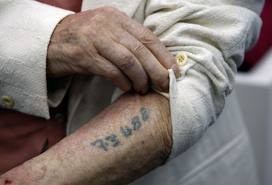
Finally, there is also a much more modern logic to Jewish disapproval of tattoos:  because body art is associated by many with the Nazi practice of tattooing numbers on the wrists of prisoners as they entered concentration and labor camps during the Holocaust. Some Jews think the past is the past and it is time to move on. Others mark themselves defiantly in solidarity with those who perished during World War II. But some find body art to be an abhorrent and gruesome reminder of the horrors suffered by so many, and feel it is a giant F.U. to the memory of martyrs to willingly choose to mark their own skin when so many were forced to endure markings and would have done nearly anything to avoid such degradation.

Whatever the law was originally meant for and the reasoning behind its creation, permanent paint has become a part of modern society, for better or for worse. Choosing to change your pigment, whether through natural, sun-based methods, or unnatural permanent inks and brandings, is a matter of personal choice.  These decisions are personal in nature, much like piercings, hair color, abortion, sexual preference and even diet. In my opinion, no governing body or spiritual faith should ever have the right to mandate people’s personal choices regarding their own bodies, so long as those choices do not negatively affect or infringe upon another person’s safety, freedoms and rights.

Unfortunately, we are not quite there yet as a society. And most frightening, as fucked up as we may think things are in the United States regarding personal choices (like gay rights and drug laws, to name a few), America is actually light years more evolved as a society than the majority of the world. Never forget that all of our ancestors came here to escape persecution and to find freedom – and as bad as things may seem at times here, it could be much, much worse if we lived elsewhere.

As for cremation, most religions at their strictest core frown upon the practice. Hinduism is unique among the world’s major religions in that it actually mandates cremation, known as antim-sanskar (“last rite”) or antiesthi (“last sacrifice”), and is one of the 16 Hindu life rituals. Cremation is believed not only to dispose of the body in this life but also to usher the soul into the next world or its rebirth into the next life. Followers of Jainism and Sikhism also strongly prefer cremation, although the doctrines do not strictly require it.

Cremation was also big among the Nordics, and findings date some of the earliest cremations to what is now Finland during the Stone Age.  Vikings adopted the practice, spread it around the region, and have left vivid images of funeral pyres aboard ships sailing into the sunset. Cremation remains the most popular funeral rite in much of Scandinavia today.

Islamic tenets instruct followers to bury their dead as quickly as possible, preferably within the day of the death. (Because Islamic beliefs loathe any practice seen as desecrating a Muslim body also means that there is a shortage of cadavers for medical research in Muslim countries.)

Eastern Orthodox Church prohibits cremation because it as a departure from the belief in resurrection. Mormons, or the Church of the Latter Day Saints (LDS), strongly support burial over cremation, although apparently the “Book of Mormon” allows cremation in cultures where it’s customary.

The importance and sacrament of the body, as well as the fact that groups that opposed the church advocated cremation, led to the Roman Catholic Church’s long-time opposition to cremation, although it wasn’t technically against church dogma. In the 1960s, canon law was relaxed and the church reiterated that cremation was allowed without penalty. Requiem Mass can be held with a body that would be cremated or, upon permission of the local bishop, with the cremated remains.

Protestant denominations have historically been more open to the idea of cremation and even advocated for burial reforms at the turn of the century.

As for the Jews, while cremation was known in the ancient world, the universal Jewish practice until the late 19th century when cremation became popular was to bury the dead in the ground or in mausoleums. In modern times, Reform Judaism has little objection to cremation, although it normally favors burial. Orthodox and, to a very large extent, Conservative Judaism frown severely on cremation. Orthodox Rabbis have been especially virulent in their opposition to the practice.

The following are the objections to cremation among Jews, and as with everything, some more convincing than others:

1. Cremation was a pagan practice in ancient times – as previously stated, many laws and practices were adopted based on threats and fears of the time, and pagan societies were a large threat and fear at the dawn of Judaism. Practices like tattoos and cremation, often became tainted by association.

2. The Talmud (Sanhedrin 46b), after a lengthy discussion, comes to the conclusion that it is a religious obligation to bury the dead and when cremation takes place this obligation has not been fulfilled.

3. The Talmud (Hullin 11b) also states that it is forbidden to mutilate a corpse. When a dead body is buried, decomposition takes place as a natural process, whereas in cremation the human remains are intentionally destroyed. A comparison is made with a Scroll of the Torah, a Sefer Torah. Even when this is no longer usable, because the letters have faded, it is reverentially buried in the soil rather than destroyed directly.

The analogy is far from exact since the Scroll is a sacred object. Nevertheless, the point of the analogy is that there should be reverential disposal of what was once a human being, created in God’s image, who carried out the precepts of the Torah while he was alive.

4. My personal favorite, but arguably the weakest, among the objections comes from a Talmudic legend (Gittin 56b), which centers around the emperor Titus, who ordered that his corpse be cremated and his ashes scattered in order to escape God’s judgment. It is therefore argued that anyone who wishes his body to be cremated thereby demonstrates a lack of belief in the resurrection of the dead and in God’s judgment.

This objection fails on two pretty significant levels: first, if God is omnipotent, how can it be beyond God’s power to reconstitute a body that has been cremated, just as it is in God’s power to reconstitute a body that has become decomposed in the grave.

Second, research yielded this nugget:  apparently there exists a notion or myth that there is a tiny bone in the human body which does not suffer decay in the grave and from which the resurrected body is reconstituted (making cremation forbidden because this bone is destroyed by fire). I am hoping this belief belongs more to folklore than to Jewish doctrine because the corpses of Jews who perished in the gas chambers during the Holocaust were burnt in crematoria. Surely these Jews are not denied their place in the Hereafter because they were not buried.

5. The most frequent argument against cremation seems to be on grounds of tradition, that it is wrong to depart from the custom of burial practiced by Jews for thousands of years.

6. Again, the history of Nazi cremation of Jews during the Holocaust also influences the opinion of both secular and religious Jews against cremation much in the same manner of tattoos and body art.

7. Moreover, an objection has recently emerged with little or no religious basis. Cremation has become unpopular among ecologists and the environmentally conscious concerned that the atmosphere should not be polluted.

The arguments for cremation are far fewer, at least among Jews, and not that well reasoned, in my opinion.

Some claim spatial concerns when arguing in favor of cremation, and that land is better used by the living. In places such as Japan, this argument has merit, and it is not surprising that in Japan cremation is used nearly 99% of the time. But even for traditional burial, the amount of land involved is very small, and graveyards are usually situated in the countryside. Furthermore, mausolea allow many people to be interned on very small plots of land. In any event, crematoria usually have spacious gardens attached to them which also take up space.

Another argument in favor of cremation is that of quick disposal, which the bereaved family does not witness, thus helping to spare their feelings. Even if this were true, a dubious proposition, Judaism does not encourage any refusal to acknowledge either the facts of life or the facts of death.

The best argument in favor of cremation is simply: while religious views and historical traditions have a strong influence on funerary practices, so too do societal, economic and ecological needs.

But again, like with tattoos and piercings, this should come down to personal preference. And if the deceased has no will or has not otherwise conveyed their wishes, then the decision should come from their next of kin. As long as cremation is legal in the society in which a person lives, it should remain an option.

Perhaps you shouldn’t snort another man or woman’s ashes, as Keith Richards once did with his father’s remains. But you should certainly be free to scatter them into the wind, and all over the Dude’s face and shirt as Walter Sobchak once did with Donny’s ashes in the film from which this blog’s name derives.


Leave a comment

Filed under Current Events, Entertainment

Our President’s Latest Opinion of the Map of Israel….

…Karen Carpenter, god rest her soul, had a greater surface area and fuller figure. At least BO’s true colors were finally exposed to the world – we all knew this day was inevitable.

Leave a comment

Filed under Current Events, Politics