
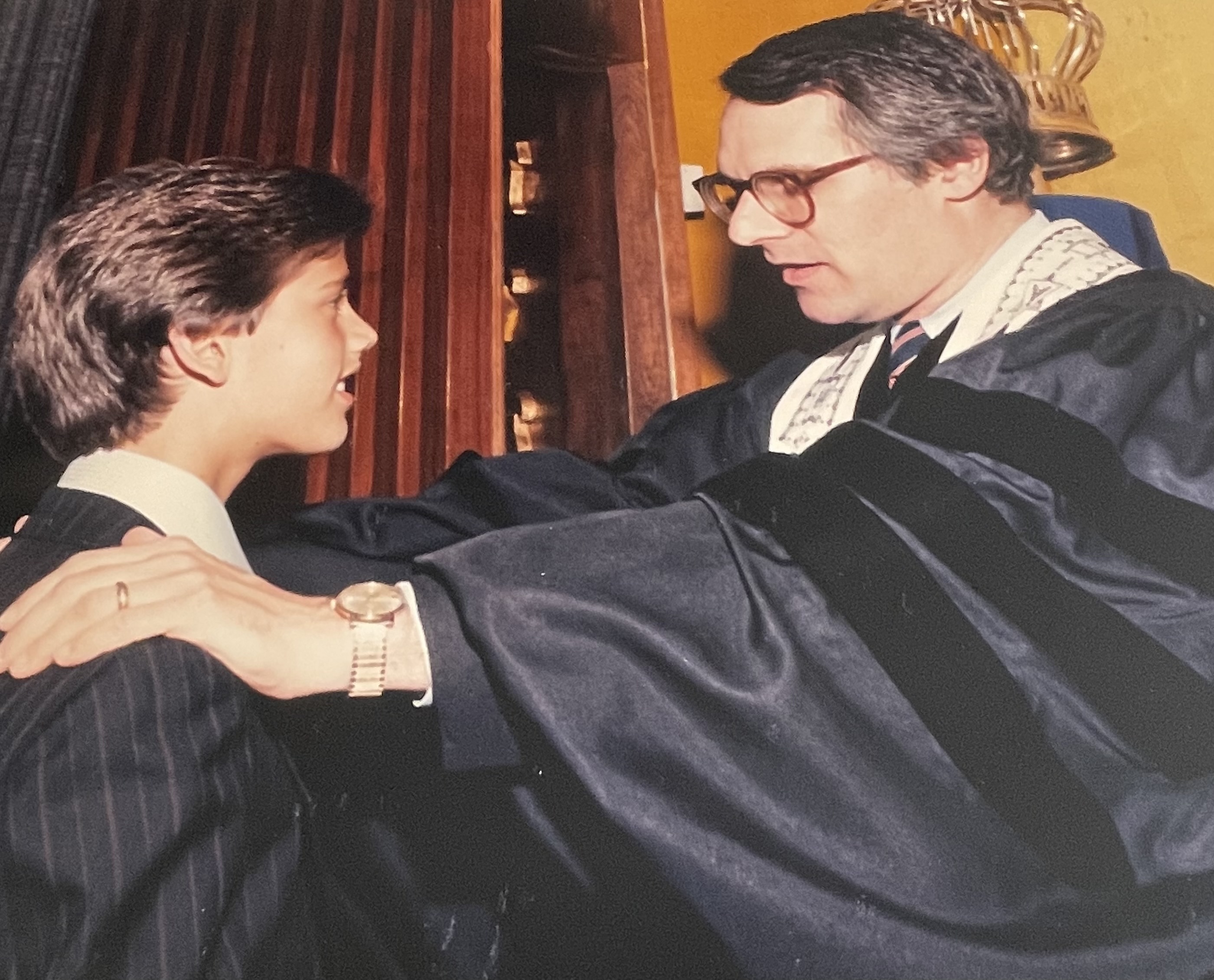
IDROS was called to the bima as a bar mitzvah 40 years ago today. A soon to be comedian was his rabbinic mentor (honestly…IDROS couldn’t make this up). IDROS had watched his peers called to read and chant Torah in the preceding weeks and months, regaling as best an adolescent going through the strange time of puberty could, in their ritualistic ascension to adulthood in the Judaic faith; learning the cadence and order of the service he was to soon lead; whispering and sharing laughs in the pews with his classmates; and watching with envy and curiosity as, toward the end of each service, our rabbi placed his hands on the shoulders of each week’s bar/bat mitzvah honoree and whispered something seemingly profound to the “newly anointed adult.”
IDROS finally had his answer 40 years ago. And the message, he learned, was for his ears only. But let’s just say IDROS could see and hear the raw tools of a budding stand-up comedian as those words echoed in the eerie silence beneath the ner tamid and ushered your humble author into manhood.
On May 2, 1986, IDROS had a twin…not a doppelganger, but a spiritual twin, a Refusenik in the then Soviet Union, who was unable to truly celebrate his own bar mitzvah in the Cold War era USSR due to religious persecution. IDROS had a chair with David’s name on the bima and acknowledged and shared the rituals with David and his family throughout the service. (Think twinning, but with no tiger blood).
Parashat Achrei Mot, which IDROS read on his big day, opens in the shadow of loss, after the deaths of Nadav and Avihu (Moses’ nephews, and Aaron’s sons) reminding us that closeness—whether to God or to purpose—requires boundaries, humility, and awareness.
The Torah then moves into Yom Kippur, a moment not just of ritual, but of deep reflection: looking inward at who we are, and outward at how we impact others.
That dual focus feels especially relevant today. Real growth doesn’t come from introspection alone—it comes when personal honesty translates into how we treat people, how we show up in community, and how we take responsibility beyond ourselves.
In many ways, this mirrors the ongoing story of the State of Israel. It’s a society constantly balancing internal identity with external challenges—asking not just “Who are we?” but “How do we act in the world?” Ironically, in this parsha, the term “scapegoat” was coined. Ironic because the Jewish people invented the term and its meaning and have been scapegoated themselves throughout history for the ills of society.
The parsha reminds us that holiness isn’t isolation. It’s the ability to hold both: self-examination and ethical action.
So the takeaway is simple but demanding: look inward with honesty, act outward with integrity, and understand that real meaning lives in the tension between the two.
And as for the deeper meaning behind the number 40, there are many appropriate gematria (IDROS loves numbers and their significance). The Hebrew letter Mem has a numerical value of 40, which also represents the word Mayim (water)…which played a significant role in the Jews’ exodus from bondage in Egypt. In fact, the number 40 is associated with transformation and renewal, much like a bar/bat mitzvah. The number also corresponds twice to the events closely associated with the parsha IDROS read, including Moses’ 40 days on Mount Sinai and the Jews 40 years wandering the desert.
Hope you found this meaningful.
Wishing you all a Shabbat Shalom and may true peace and fulfillment fill your lives.
Thanks as always for reading!
IDROS

